Project video
The project video is not available at the current media URL.
Abstract
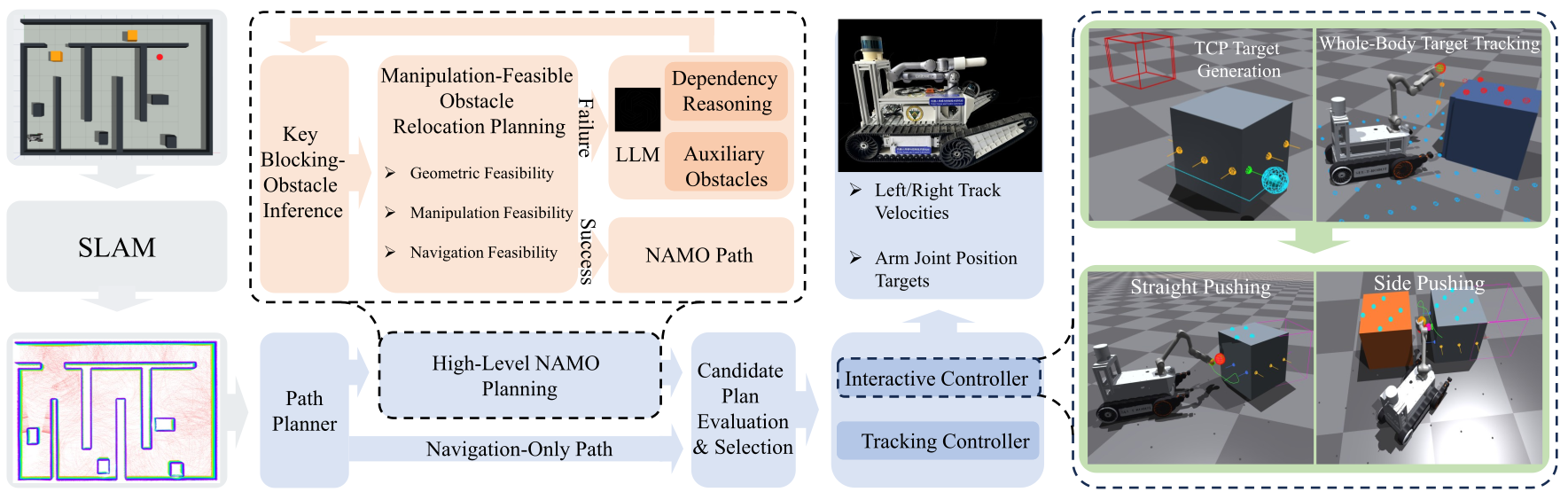
In environments with large movable obstacles, detour-only navigation can be inefficient or even infeasible, while obstacle interaction requires reasoning about navigation benefit, feasible placement, and executable manipulation. We present a hierarchical navigation among movable obstacles (NAMO) framework for mobile manipulators. At the high level, the planner identifies key blocking obstacles from reference paths and searches for relocation plans that jointly satisfy geometric, manipulation, and downstream navigation constraints. When direct relocation is hindered by other movable objects, a large language model (LLM) is selectively invoked to infer auxiliary manipulation dependencies, which are then verified by deterministic geometric planning. To execute the resulting relocation goals, we define discrete contact modes on box surfaces and select contact faces and regions online from position and orientation errors, enabling straight, lateral, and corner pushing through contact switching. A recurrent reinforcement-learning policy coordinates the mobile base and manipulator to track tool center point (TCP) targets while preserving end-effector reachability during sustained pushing. Simulation and real-robot experiments demonstrate feasible navigation–manipulation in detour, single- and multi-obstacle relocation, and non-local dependency scenarios, validating the framework for interactive navigation with large non-graspable obstacles. The open-source project will be released soon.
Framework Overview
Execution
Pushing Skill Demonstration
Video is not available at the current media URL.
Video is not available at the current media URL.
Video is not available at the current media URL.
Video is not available at the current media URL.
Video is not available at the current media URL.
Video is not available at the current media URL.
Video is not available at the current media URL.
Video is not available at the current media URL.
Evaluation
Simulation Experiments
Video is not available at the current media URL.
Video is not available at the current media URL.
Video is not available at the current media URL.
Video is not available at the current media URL.
Video is not available at the current media URL.
Video is not available at the current media URL.
Video is not available at the current media URL.
Deployment
Real-World Experiments
Video is not available at the current media URL.
Video is not available at the current media URL.